Studio Lighting on a Budget: Comparing Three Setups
By Elena Park · Published · 3 minutes read
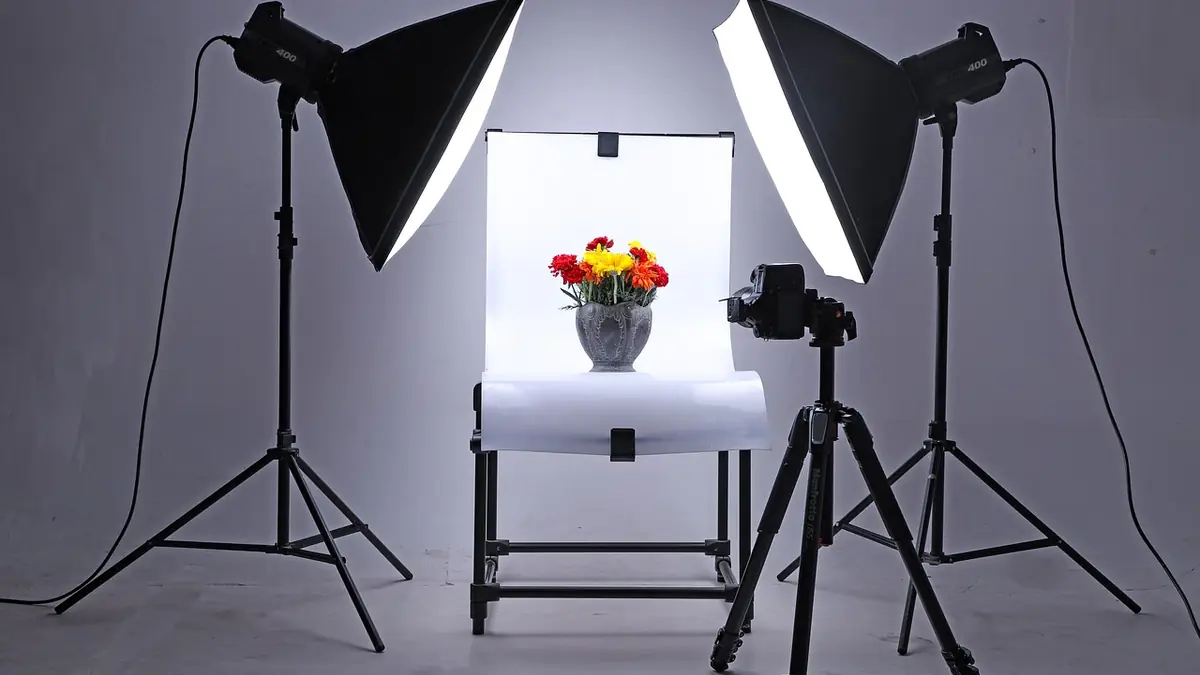
Setting up a photo studio on a tight budget forces trade-offs. You need enough light to shape a subject, but you also need to fit the gear into a spare room and keep the total spend under control. The three most common paths are continuous LED kits, speedlights with modifiers, and entry-level strobes.
Each has a different cost profile, space requirement, and learning curve. This comparison looks at typical price ranges, how much room each setup needs, and what kind of output you can expect, so you can pick the one that matches your space and the work you actually shoot.
Continuous LED Kits: The Easy Entry
Continuous lights stay on, so what you see is what you get. That makes them forgiving for beginners and useful for video. A basic two-light kit with stands and softboxes typically costs $150–$400. Output is modest: most budget LEDs deliver the equivalent of 50–100W of tungsten, enough for headshots at f/2.8–f/4 and ISO 400–800.
The main limitation is power. You cannot freeze fast motion, and shooting at small apertures or low ISOs often forces slower shutter speeds. Colour accuracy also varies; look for a CRI of 95 or higher. For still-life, interviews, and slow-paced portraits, continuous LEDs are a practical starting point that leaves budget for modifiers and backgrounds.
- Typical cost: $150–$400 for a two-light kit
- Best for: video, still-life, beginners
- Watch for: low CRI, limited output, fan noise
Speedlights: Small, Cheap, and Powerful Enough
A manual speedlight costs $60–$150, and a kit with two lights, triggers, stands, and umbrellas can be put together for $300–$600. Speedlights are small and battery-powered, so they pack away easily and need very little floor space. They also output far more light than budget continuous sources, letting you shoot at f/8 and ISO 100.
The catch is that you are working with bare-bulb flash unless you add modifiers. Umbrellas are cheap and effective; softboxes and beauty dishes cost more but give better control. Speedlights lack modelling lights, so you learn by chimping. Recycling times of 2–4 seconds at full power slow down rapid shooting. For portraits and small products, they offer the best output-per-dollar.
- Typical cost: $300–$600 for a two-light kit with triggers
- Best for: portraits, small products, location work
- Watch for: no modelling light, slow recycle at full power
Entry-Level Strobes: Room to Grow
A single 200–400Ws monolight starts around $200–$400, and a two-light kit with stands and softboxes runs $600–$1,200. Strobes offer modelling lights, faster recycling, and higher output than speedlights. They also accept a wide range of modifiers, from large octaboxes to grids, which gives you more control over the quality of light.
Strobes need more space. A 400Ws light with a 36-inch softbox wants at least 8–10 feet of subject-to-background distance for full-length portraits. They also require access to mains power, though battery-powered units exist at a premium. If you plan to shoot regularly and have a dedicated room, strobes are the most future-proof choice.
- Typical cost: $600–$1,200 for a two-light kit
- Best for: regular portrait and product work
- Watch for: space needs, power access, higher weight
Space: How Much Room Do You Really Need?
Continuous LEDs and speedlights are compact. A 10x10-foot corner can work for headshots and small products. You need about 6 feet between the light and the subject, and another 3–4 feet behind the subject for a background. Speedlights on stands with umbrellas take up similar space but can be tucked away when not in use.
Strobes with large modifiers need more room. A 36x48-inch softbox on a stand occupies a 4-foot footprint and should sit 4–6 feet from the subject. For full-length portraits, allow 12–15 feet of length. Ceiling height matters too: stands for large softboxes can reach 8–9 feet. Measure your space before buying, and favour modifiers that collapse or rotate to save room.
- Headshots: 8x10 feet minimum
- Full-length portraits: 12x15 feet preferred
- Ceiling height: at least 9 feet for large softboxes
Output Quality: What You Can Realistically Expect
Budget continuous LEDs often struggle with colour consistency across dimming levels and can flicker at certain shutter speeds. Speedlights produce consistent colour around 5500–6000K, but bare flash is harsh; the quality of light depends entirely on your modifiers. Entry-level strobes offer more consistent output and better modifier compatibility, but cheap units may vary in colour temperature by ±200K from shot to shot.
In practice, the biggest quality difference comes from modifier size and placement, not the light source itself. A $100 speedlight in a $40 umbrella can look better than a $500 strobe with a small, hard reflector. Budget for at least one large soft modifier, and learn to feather and position it before upgrading lights. See our portfolio review checklist for how clients judge lighting in final images.
| Setup | Typical kit cost | Output (approx.) | Space needed | Best for |
|---|---|---|---|---|
| Continuous LED (2 lights) | $150–$400 | 50–100W tungsten equivalent | 8x10 ft corner | Video, still-life, beginners |
| Speedlights (2 lights + triggers) | $300–$600 | Guide number 30–60m at ISO 100 | 8x10 ft corner | Portraits, small products, location |
| Entry-level strobes (2 lights) | $600–$1,200 | 200–400Ws per light | 12x15 ft room | Regular portrait and product work |
| Continuous LED (single high-output) | $200–$350 | 100–150W equivalent | 6x8 ft corner | Interviews, close-up work |
| Speedlight (single + umbrella) | $120–$250 | Guide number 40–60m | 6x8 ft corner | Headshots, fill light |
Hidden Costs: Triggers, Modifiers, and Power
The kit price rarely tells the whole story. Speedlights need radio triggers ($40–$100 per pair) and receivers if not built in. Strobes often use proprietary triggers that cost $50–$150. Modifiers add up quickly: a basic softbox is $30–$80, a good umbrella $20–$50, and a beauty dish $80–$150. Stands and brackets are another $30–$60 each.
Power is another consideration. Continuous LEDs draw little power, but bright ones can trip household circuits if combined with other gear. Strobes have high peak draw but short duration. Battery-powered strobes avoid outlets but cost 30–50% more. Always budget 20–30% above the kit price for the accessories you will actually need. For help estimating time on set, read how to estimate time for photo retouching projects.
- Continuous LEDs are cheapest and easiest for video and still-life, but lack power for fast or low-ISO work.
- Speedlights offer the best output-per-dollar for portraits if you accept manual exposure and no modelling light.
- Entry-level strobes cost more and need more space, but provide modelling lights and modifier flexibility for regular studio work.
- Budget 20–30% above the kit price for triggers, modifiers, and stands; the light source matters less than the modifier size.
Elena writes about portfolio strategy, client communication, and the day-to-day operations of running a studio. She draws on common industry challenges to create actionable checklists and how-to articles. Her focus is on helping creative professionals present their work clearly and confidently.